1099 vs W2: What It Actually Means for Your Taxes and Paycheck
Someone just offered you a contract role paying $80 an hour as a 1099 contractor. Your current W2 job pays $60 an hour. Sounds like an obvious upgrade, right?
Sit down. We need to talk about the math first.
Most people who make the jump from W2 to 1099 work do it without fully understanding what changes. They see the higher rate, they say yes, and then April rolls around and they're staring at a tax bill that makes no sense to them. This article exists so that doesn't happen to you.
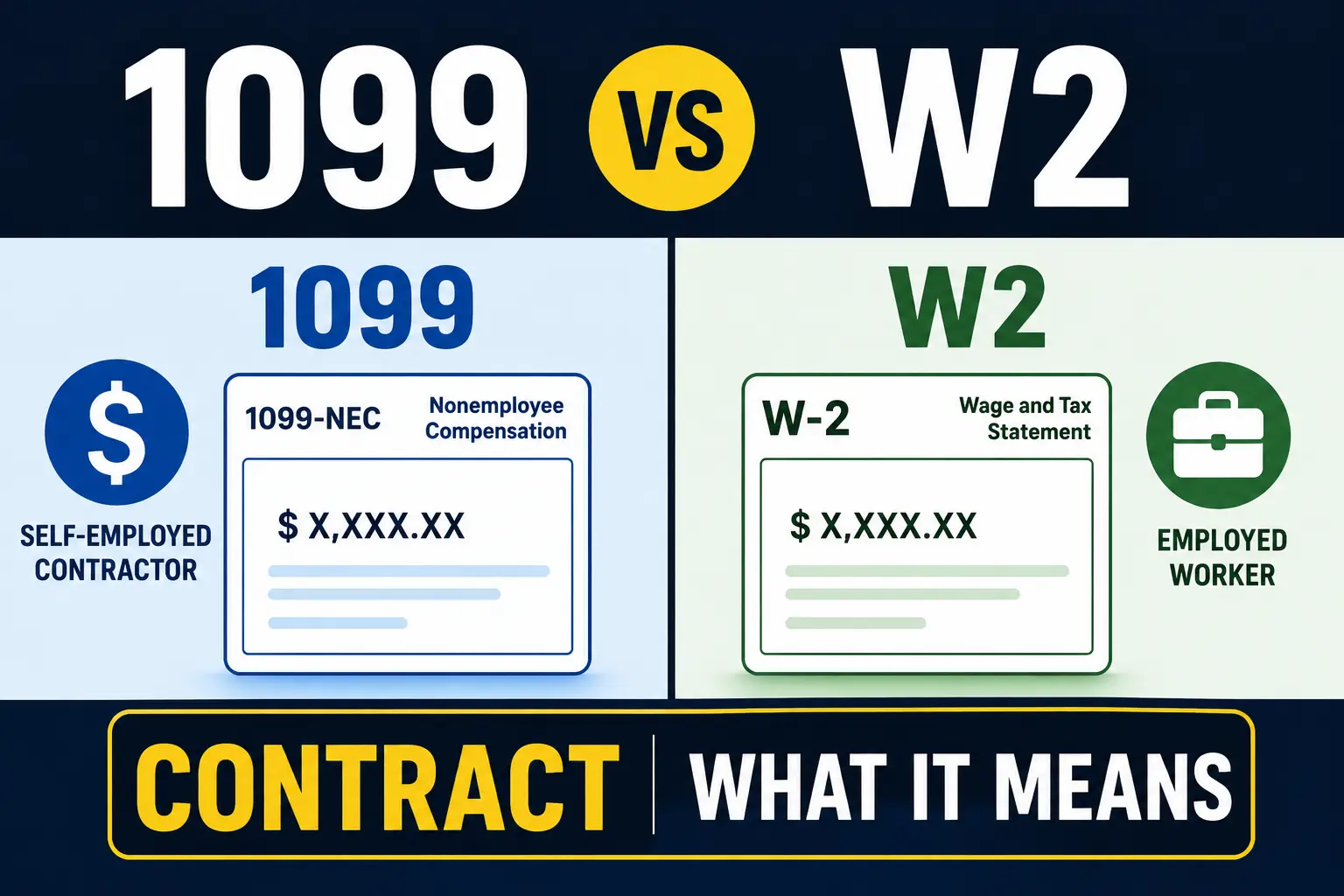
What W2 Actually Means
When you're a W2 employee, you're on a company's payroll. Every pay period, your employer calculates how much tax you owe, withholds it from your paycheck, and sends it directly to the IRS and your state tax authority. By the time the money hits your bank account, the government has already been paid.
Your employer also pays half of your Social Security and Medicare taxes — a combined 7.65% of your wages — out of their own pocket, completely separate from your salary. You never see this money, you never touch it, but it's real compensation your employer is spending on your behalf every single pay period.
On top of that, W2 employment typically comes with benefits — health insurance, paid time off, a retirement plan with employer matching, sometimes dental and vision, life insurance, and all the legal protections that come with being classified as an employee. Unemployment insurance if you get laid off. Workers' compensation if you get hurt on the job. Protections under employment law that contractors don't have.
At the end of the year you get a W2 form summarizing everything — total wages paid, total taxes withheld. You hand it to your accountant or plug it into tax software and you're done. The complexity is low because most of the work happened automatically throughout the year.
What 1099 Actually Means
When you're a 1099 contractor, you're self-employed. A client pays you and you receive the full amount — no withholding, no deductions, the whole check. That feels great right up until you realize that money isn't all yours.
Nobody withholds anything on your behalf. Nobody pays half your Social Security and Medicare. Nobody provides health insurance or pays time off or contributes to a retirement plan. All of that is now your responsibility. The flexibility and independence of contract work comes with a real administrative and financial cost that most people underestimate going in.
You're also required to pay taxes four times a year through quarterly estimated payments — April, June, September, and January. Miss these and the IRS charges underpayment penalties on top of whatever you owe. Get them wrong and you either overpay and wait for a refund or underpay and get hit with interest. There's no employer smoothing this out for you.
At tax time you receive 1099-NEC forms from any client who paid you $600 or more during the year. These get reported directly to the IRS — meaning they already know about this income before you file. There's no hiding it, no gray area, and no forgetting about it. Report everything and pay what you owe.
The Tax Math — Where It Gets Real
Here's the part that genuinely surprises most people making the switch.
As a W2 employee, your employer covers half your FICA taxes — 7.65% of your wages for Social Security and Medicare. You pay the other 7.65% through payroll withholding. You see the employee share on your pay stub but the employer share is invisible to you even though it's real money being spent on your behalf.
As a 1099 contractor, you pay both halves. The full 15.3%. On your own. This is called self-employment tax and it applies to 92.35% of your net earnings — meaning your gross income minus legitimate business expenses. It's not optional, it's not negotiable, and it applies regardless of how much or how little you make above the $400 threshold.
So right away, before federal income tax even enters the picture, you're paying an additional 7.65% compared to what you paid as a W2 employee at the same income level. That's the invisible employer contribution you're now funding yourself.
Then on top of self-employment tax, you still owe regular federal income tax on your profits, calculated the same way as any other taxpayer — taxable income after deductions, applied to the progressive brackets. The one small consolation: you can deduct half of your self-employment tax from your gross income before calculating your federal income tax, which reduces the bite slightly.
Add it all together and most 1099 contractors end up paying 25% to 35% of their net income in combined taxes. Compare that to a W2 employee at the same gross income level who typically pays 20% to 28% total. The gap is real and it's meaningful.
Side by Side: Same Income, Very Different Outcomes
Let's make this concrete. Two people, both earning $80,000 in gross income this year. One is a W2 employee, one is a 1099 contractor. Both are single filers in Texas with no state income tax.
W2 employee, $80,000 salary:
Federal income tax: roughly $9,500. Employee Social Security: $4,960. Employee Medicare: $1,160. Take-home after taxes: roughly $64,380.
And on top of that, the employer separately paid $4,960 in Social Security and $1,160 in Medicare on this person's behalf — money the employee never sees but that represents real compensation. If the employer also provides health insurance worth $500 a month, that's another $6,000 in value that doesn't show up in gross pay but absolutely shows up in quality of life.
1099 contractor, $80,000 gross income, $5,000 in business expenses:
Net profit after expenses: $75,000. Self-employment tax on 92.35% of $75,000: roughly $10,597. Federal income tax after deducting half of SE tax: roughly $9,200. Total federal tax: roughly $19,797. Take-home after taxes only: roughly $55,200.
Then subtract health insurance if you're paying out of pocket — a reasonable individual plan runs $300 to $600 a month, so call it $4,800 to $7,200 per year. After health insurance, the 1099 contractor might be taking home $48,000 to $50,400 on the same $80,000 in gross income that a W2 employee turns into $64,380 plus employer-provided health coverage.
That's a difference of $14,000 to $16,000 per year in real take-home value. On the same gross income. That's how much the 1099 rate needs to be higher to genuinely come out ahead.
How Much Higher Does the 1099 Rate Need to Be?
A commonly used rule of thumb is that a 1099 rate should be at least 25% to 30% higher than an equivalent W2 salary to account for self-employment tax alone. Factor in health insurance and the loss of other benefits and the number climbs to 35% to 40% higher to genuinely break even.
So if a W2 job pays $60 an hour, a 1099 contract paying $75 an hour is roughly equivalent after taxes. A contract at $80 an hour starts to actually come out ahead — but only slightly, and only if you're disciplined about setting money aside for taxes and not getting surprised at filing time.
Below $75 an hour in that scenario and you're almost certainly worse off financially despite the higher-looking rate. The number on the invoice is not your take-home pay.
The exact breakeven point depends on your state tax rate, how many business expenses you can legitimately deduct, whether you have health insurance through a spouse or partner, and what benefits your W2 job actually includes. Run the real numbers for your specific situation before making a decision based on the headline rate.
The Genuine Advantages of 1099 Work
The financial math doesn't always favor 1099 work, and yet millions of people choose it. There are real reasons for that beyond just rate arbitrage.
Business expense deductions are genuinely powerful. As a 1099 contractor you can deduct equipment, software subscriptions, a home office if you use part of your home exclusively for work, professional development, a portion of your phone and internet bills, and health insurance premiums if you're self-employed and not eligible for employer coverage. These deductions reduce your taxable income, which reduces both your income tax and your self-employment tax. A $15,000 reduction in net profit saves roughly $4,500 to $5,000 in combined taxes at typical effective rates. W2 employees have almost none of these options.
Retirement savings limits are dramatically higher for self-employed people. A Solo 401(k) allows total contributions up to $70,000 in 2026 — the employee contribution limit alone matches the W2 employee limit at $23,500, but you can also contribute as the employer side up to 25% of net earnings on top of that. If you're a high earner who wants to aggressively shelter income from taxes, the self-employed retirement vehicle is genuinely superior to what a W2 employer typically offers.
The Qualified Business Income deduction — also called the QBI deduction or Section 199A — allows many self-employed people to deduct up to 20% of their qualified business income from their taxable income. Not every type of business qualifies and there are income phase-outs, but for contractors who do qualify it's a significant tax benefit that W2 employees simply don't have access to.
And beyond the financial picture, the freedom and autonomy of working for yourself has real value that doesn't show up in any tax calculation. Working with multiple clients, choosing which projects to take on, setting your own schedule, building a business rather than a career — for a lot of people these things are worth a meaningful financial trade-off. Just make sure you're making that trade knowingly, with the real numbers in front of you, rather than because you didn't realize the tax situation was as different as it is.
What Benefits Are You Actually Giving Up?
This is the calculation most people skip and most regret skipping.
Benefits have real dollar values. Most people dramatically underestimate how much their employer is spending on their behalf beyond their visible salary. Walking away from a W2 job means walking away from all of it.
A 4% 401(k) match on an $80,000 salary is $3,200 per year in free money — money that gets added to your retirement account regardless of what you contribute beyond the minimum to trigger the match. Two weeks of paid vacation on that same salary is worth $3,077 — you're being paid for time you're not working. Employer-provided health insurance that costs $600 a month if you bought it yourself is $7,200 per year in value even though it doesn't appear in your gross pay.
Add those three things together and you get over $13,000 in annual compensation value that's invisible in the W2 salary comparison. That's before dental, vision, life insurance, disability insurance, and any other perks your employer provides.
When you go 1099, all of that disappears from your compensation and becomes your expense. Factor it in before you say yes to the higher-looking rate.
A Practical Decision Framework
Before accepting a 1099 contract over a W2 position, work through these questions with real numbers rather than rough estimates.
What is the W2 equivalent of the 1099 rate? Reduce the 1099 hourly or annual rate by 30% to account for self-employment tax and the loss of employer FICA contributions. If the result is still higher than the W2 alternative, you're starting to come out ahead.
What does health insurance actually cost you if you're self-paying? Get real quotes for a comparable plan, not estimates. This number varies dramatically by age, location, and plan type and it has a huge impact on the real comparison.
How much can you legitimately deduct in business expenses? More deductions mean lower net profit, which means lower self-employment tax and lower income tax. The more you can deduct, the better 1099 work looks financially.
What is the realistic duration of the contract? Short engagements mean more time between contracts, more income uncertainty, and the administrative overhead of finding new work repeatedly. Longer engagements with stable clients look much more like employment from a practical standpoint and justify taking a smaller rate premium.
And finally — are you disciplined enough to set aside 30% of every payment immediately and leave it alone until quarterly taxes are due? If the answer is no, 1099 work will create financial stress regardless of the rate. The tax bill arrives whether or not you saved for it.
For a clear baseline on what a W2 employee takes home at any salary level, the paycheck calculator shows the full breakdown. Use it alongside the freelance tax guide to build both sides of the comparison before making a decision.