How Is Salary Calculated?
You accepted a job at $65,000 a year. Cool. But how does that number actually turn into the amount that hits your bank account every two weeks?
It's not as simple as dividing by 12. There's a whole chain of math happening between your offer letter and your paycheck — and most people have never had it explained clearly.
Let's fix that.
Step One: Gross Pay Per Period
Your annual salary gets divided by however many times you're paid per year. That gives you your gross pay per period — the starting number before anything is taken out.
The math looks like this:
Weekly (52 paychecks/year): $65,000 ÷ 52 = $1,250/week
Biweekly (26 paychecks/year): $65,000 ÷ 26 = $2,500 per paycheck
Semi-monthly (24 paychecks/year): $65,000 ÷ 24 = $2,708 per paycheck
Monthly (12 paychecks/year): $65,000 ÷ 12 = $5,417/month
Biweekly is the most common in the US. If you're not sure which one your employer uses, check your offer letter or ask HR — it matters more than people think, especially for budgeting.
Step Two: Taxes Come Out
Once you have your gross per period, taxes get subtracted. This is where most of the gap between your salary and your actual paycheck comes from.
Federal income tax is calculated based on your annual income and filing status. Your employer withholds a portion each paycheck based on the W-4 you filled out when you started. On $65,000 as a single filer, your effective federal rate ends up around 12-13%.
Social Security takes 6.2% of every paycheck — flat rate, no exceptions, up to the 2026 wage base of $184,500.
Medicare takes another 1.45%, also flat, no cap.
State income tax depends entirely on where you live. Nine states charge zero — Texas, Florida, Nevada, Washington, Wyoming, South Dakota, Alaska, Tennessee, and New Hampshire. Everyone else pays something, ranging from a flat 3% in some states to over 13% at the top in California.
Step Three: Other Deductions
After taxes, anything else you signed up for during onboarding comes out too.
Health insurance premiums, 401(k) contributions, dental, vision, HSA or FSA contributions — all of these are deducted from your paycheck before you see the money. Some of them (like 401k and HSA) come out pre-tax, which actually reduces how much income tax you pay. Others come out post-tax.
This is why two coworkers with the exact same $65,000 salary can have paychecks that are hundreds of dollars apart. One maxed their 401(k) and has the premium health plan. The other has basic coverage and no retirement contributions. Same gross, completely different net.
What's Left Is Your Net Pay
Gross pay minus all taxes minus all deductions equals your net pay. That's what lands in your bank account.
On $65,000 in a state with no income tax, as a single filer with no voluntary deductions, you'd take home roughly:
Federal tax: ~$7,800/year
Social Security: ~$4,030/year
Medicare: ~$942/year
Take-home: ~$52,228/year → ~$2,009 per biweekly paycheck
Add a state like California and it drops another $3,000-$4,000. Add health insurance and 401(k) and you could realistically be taking home $1,600-$1,700 per paycheck on a $65,000 salary.
Want the exact number for your situation? Run it through the paycheck calculator — it handles all the math based on your state and filing status.
How Hourly Wages Turn Into a Salary
If you're paid hourly rather than salaried, the starting calculation is different. Instead of dividing an annual number, you multiply up:
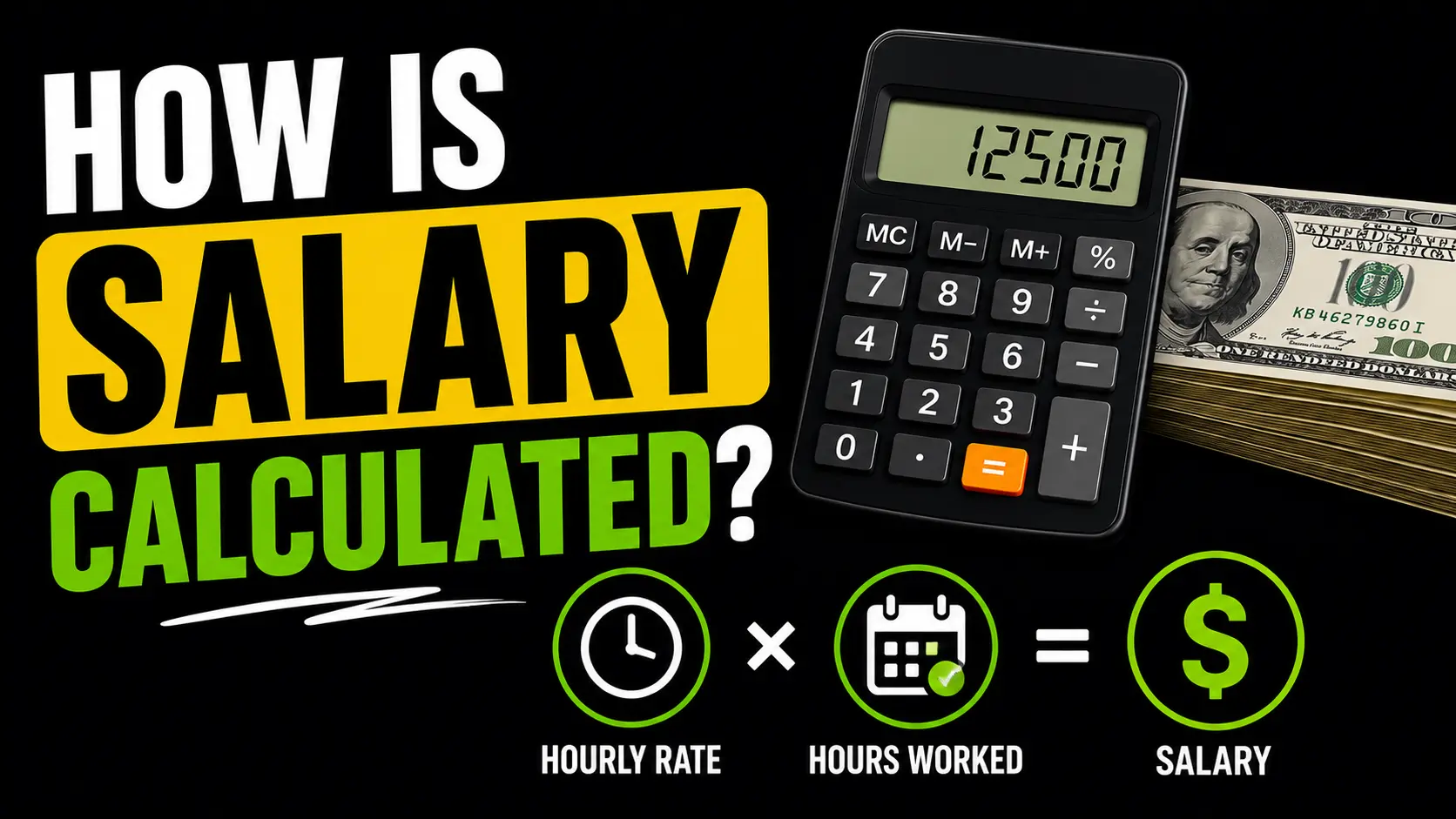
Hourly rate × hours per week × 52 weeks = annual equivalent salary.
So $25/hr at 40 hours a week works out to $52,000 a year in gross pay. From there, the same tax and deduction logic applies — you're just starting from a different gross number.
The key difference: hourly workers usually get overtime pay (1.5x their rate) for hours above 40 per week. Salaried employees generally don't, which is why the hourly-vs-salary decision matters more than just the base number suggests.
How Employers Decide What Salary to Offer
This part most people never think about — but it affects every job offer you'll ever get.
Employers set salary ranges based on a few things: market data (what similar roles pay in your region), internal pay bands (what people at the same level already earn), budget constraints, and sometimes individual negotiation. Most companies use salary benchmarking tools that pull data from surveys and job postings to anchor their ranges.
That's why two people in the same role at different companies can earn wildly different salaries — and why researching market rates before negotiating matters so much. Sites like Glassdoor, Levels.fyi (for tech), and the Bureau of Labor Statistics Occupational Outlook Handbook are all worth checking before any salary conversation.
Does Your Salary Change Throughout the Year?
If you're a standard salaried employee, each paycheck should be the same amount (assuming no changes to your benefits or withholding). The exception is biweekly pay — because 52 weeks ÷ 2 = 26 paychecks, and some months will have three paycheck dates instead of two. Your per-paycheck amount stays the same, but you'll see a "bonus" paycheck a couple of times a year.
Salary changes mid-year (raises, promotions) get applied from the effective date forward — your employer recalculates the per-period amount based on the new annual salary and starts using it on the next payroll run.