How to Calculate Net Pay After Taxes
Most articles about this are written for HR managers and payroll software companies. This one isn't.
This is for you. The person who just got a job offer, divided their salary by 26, and wants to know why their actual paycheck is going to be so much lower than that number.
Here's exactly how net pay is calculated, step by step, in plain English.
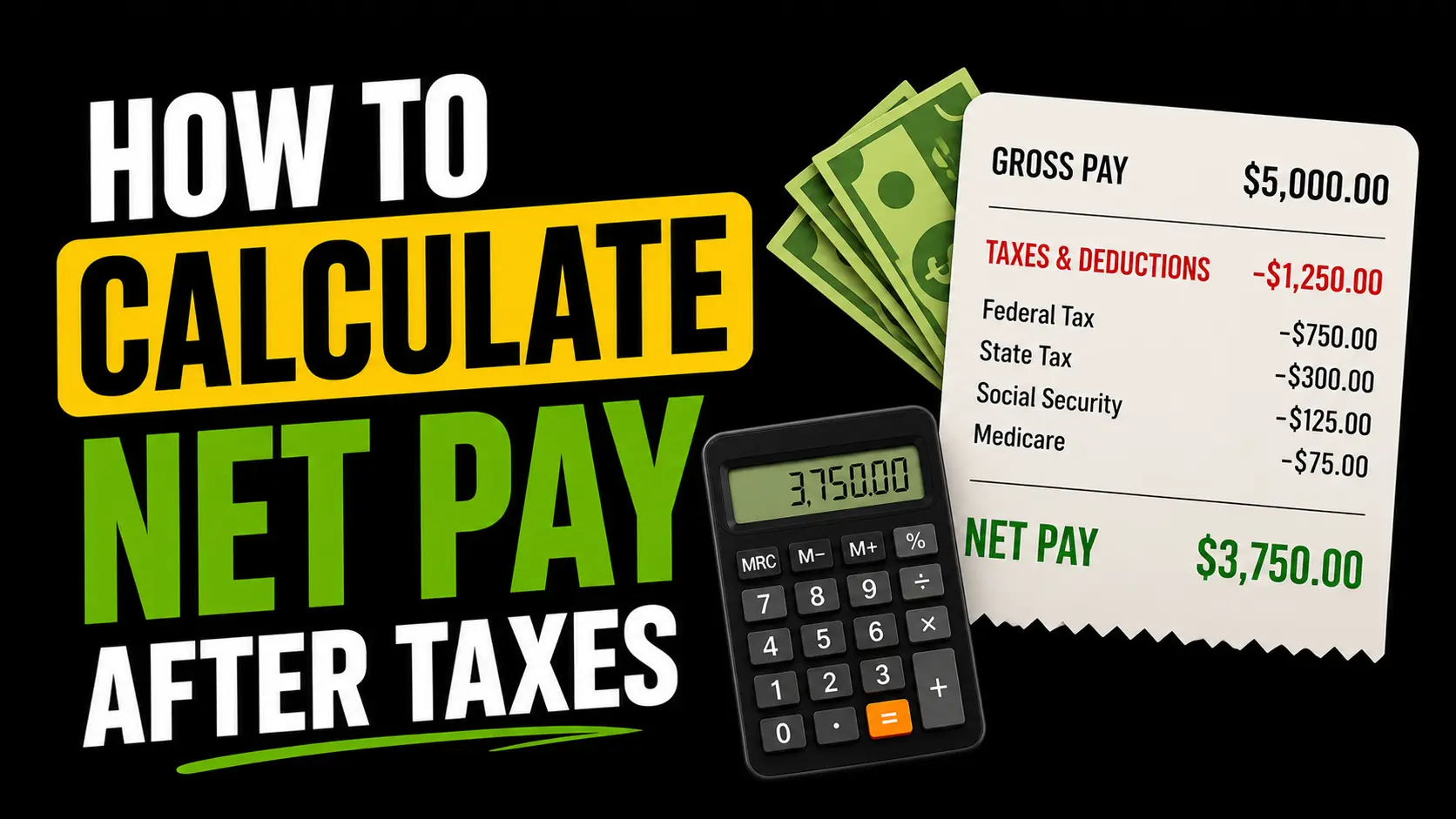
Step 1: Start With Your Gross Pay
Gross pay is your starting number. For a salaried employee, it's your annual salary divided by the number of pay periods in a year.
Weekly pay (52 periods): salary divided by 52.
Biweekly pay (26 periods): salary divided by 26.
Semi-monthly pay (24 periods): salary divided by 24.
Monthly pay (12 periods): salary divided by 12.
On a $58,000 salary paid biweekly: $58,000 divided by 26 equals $2,230.77 gross per paycheck.
That's your starting line. Everything after this reduces it.
Step 2: Subtract Federal Income Tax
Federal income tax is the biggest deduction for most people. The US uses a progressive bracket system, meaning different portions of your income get taxed at different rates.
Here's how it actually works. As a single filer in 2026, the first $11,925 of your taxable income is taxed at 10%. The next chunk up to $48,475 is taxed at 12%. Then 22% up to $103,350. You only pay the higher rate on income above each threshold, not on your whole salary.
Your taxable income isn't your full salary either. First you subtract the standard deduction, which is $15,000 for single filers in 2026 and $30,000 for married filing jointly. That's income you're not taxed on at all.
So on $58,000 as a single filer, your taxable income is $58,000 minus $15,000, which equals $43,000. Federal tax on that works out to roughly $4,900 for the year, or about $188 per biweekly paycheck.
Step 3: Subtract FICA Taxes
FICA stands for Federal Insurance Contributions Act. It's two separate taxes bundled together on your pay stub.
Social Security takes 6.2% of every paycheck, up to the 2026 wage base of $184,500. Medicare takes another 1.45% with no cap. Combined, that's 7.65% off the top of your gross pay, no exceptions.
On our $2,230.77 biweekly paycheck, FICA comes out to about $170.65 per period. Every single paycheck, regardless of what else is going on with your taxes.
Step 4: Subtract State Income Tax
This one depends entirely on where you live.
Nine states charge zero income tax on wages: Texas, Florida, Nevada, Washington, Wyoming, South Dakota, Alaska, Tennessee, and New Hampshire. If you live in one of these, skip this step entirely.
Everyone else pays something. California goes up to 13.3% for high earners. New York sits around 6% for most middle-income filers. Some states have flat rates, others have brackets like the federal system. The range across all states is roughly 2% to 10% for a typical middle-income salary.
On $58,000 in a state with a flat 5% rate, you'd pay roughly $2,900 per year in state tax, or about $111 per biweekly paycheck.
Step 5: Subtract Any Voluntary Deductions
This is the step most people forget about when they're trying to estimate their paycheck before starting a new job.
If you signed up for health insurance through your employer, your share of the premium comes out of each paycheck. If you're contributing to a 401(k), that percentage comes out too. Same for dental, vision, HSA, or FSA contributions.
Some of these are pre-tax, meaning they reduce your taxable income before federal and state tax are calculated. A 5% 401(k) contribution on $58,000 reduces your taxable income by $2,900, which slightly lowers your federal tax bill. Health insurance premiums work the same way.
Post-tax deductions like Roth 401(k) contributions come out after taxes are calculated, so they don't reduce your tax bill but they also don't affect your taxable income.
What You're Left With: Net Pay
After all of that, here's what our $58,000 example actually looks like per biweekly paycheck, single filer, no state income tax, no voluntary deductions:
Gross pay: $2,230.77
Federal income tax: $188
Social Security: $138
Medicare: $32
Net pay: roughly $1,872 per paycheck
Add a state income tax of 5% and it drops to about $1,761. Add health insurance and a 5% 401(k) contribution and you could realistically be looking at $1,550 to $1,650 per paycheck on a $58,000 salary.
That gap between $2,230 and $1,600 is exactly why people are always surprised by their first paycheck. Now you won't be.
If you want your exact number without doing all this math by hand, the paycheck calculator handles all of it in a few seconds based on your actual salary, state, and filing status.
The Quick Formula
If you want to summarize it in one line:
Net Pay = Gross Pay minus Federal Tax minus FICA minus State Tax minus Voluntary Deductions
Each piece of that formula has its own rules and rates, but that's the structure. Gross pay goes in at the top and net pay comes out at the bottom after everything is subtracted along the way.