How to Calculate and Pay Quarterly Estimated Taxes (Step-by-Step)
Nobody tells you about quarterly taxes when you go freelance. You find out the hard way — usually when you file your first return and discover you owe a lump sum you weren't expecting, plus penalties for not paying it throughout the year.
This article exists so that doesn't happen to you. By the end you'll know exactly how quarterly estimated taxes work, how to calculate what you owe each quarter, both legitimate methods for doing it, how to actually send the money to the IRS, and what happens if your income is uneven throughout the year.
What Quarterly Estimated Taxes Are and Who Owes Them
When you work a W2 job, your employer withholds taxes from every paycheck and sends them to the IRS on your behalf throughout the year. The IRS receives money from you continuously, not in one annual payment.
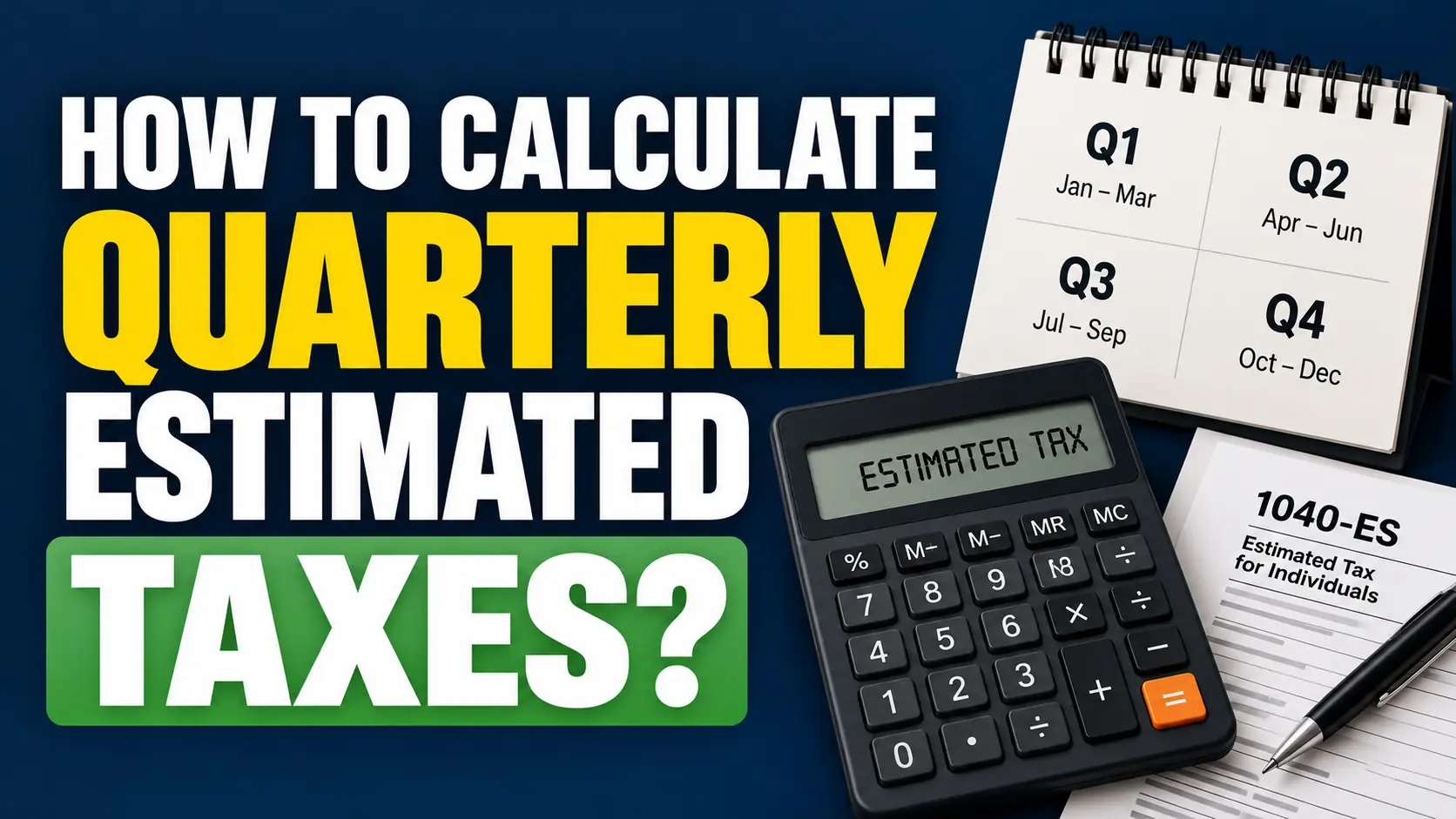
When you're self-employed, no one withholds anything. The IRS still expects to receive money throughout the year — they just expect you to send it yourself. That's what estimated quarterly taxes are: four payments per year that approximate what you'll owe at filing time, paid in advance so you're not writing one enormous check in April.
You're required to make quarterly estimated payments if you expect to owe at least $1,000 in federal taxes for the year after subtracting any withholding and credits. For most self-employed people with meaningful income, this threshold is crossed quickly. Even a side income of $10,000 above your W2 wages can push you over it.
This applies to sole proprietors, freelancers, independent contractors, single-member LLC owners, partners in partnerships, and S-corp shareholders who pay themselves. If any of those describe you and you're not having taxes withheld elsewhere that cover your liability, you need to be making quarterly payments.
The 2026 Quarterly Tax Deadlines
The IRS quarters don't map neatly to calendar quarters, which trips people up. Here are the actual deadlines for 2026:
Q1 (January 1 – March 31): Payment due April 15, 2026
Q2 (April 1 – May 31): Payment due June 16, 2026
Q3 (June 1 – August 31): Payment due September 15, 2026
Q4 (September 1 – December 31): Payment due January 15, 2027
Notice that Q2 only covers two months, not three. This is a quirk of the IRS calendar that catches people off guard. You have less time to earn income in that period but the same payment is still expected.
If a deadline falls on a weekend or federal holiday, it shifts to the next business day. When in doubt, pay a day or two early — there's no benefit to cutting it close and the penalties for lateness compound quickly.
What You're Actually Paying Each Quarter
Each quarterly payment covers two things: your estimated income tax and your estimated self-employment tax for that period. Both get combined into a single payment — you don't send them separately.
Self-employment tax is 15.3% applied to 92.35% of your net self-employment earnings (the 92.35% adjustment accounts for the employer-side deduction). Income tax is calculated on top of that, using the same federal brackets as any other taxpayer, after the standard deduction and the deduction for half of your SE tax.
The full mechanics of how self-employment tax works are covered in the self-employment tax guide. Here we're focused on the quarterly payment process specifically.
Method One: The Safe Harbor Method (Easiest)
The IRS safe harbor rule is the simplest way to handle quarterly taxes without doing precise calculations every quarter. If you pay enough throughout the year to meet the safe harbor threshold, the IRS won't charge you underpayment penalties — even if you end up owing more at filing time.
There are two safe harbor thresholds:
100% of last year's tax liability. If your adjusted gross income last year was $150,000 or less, you can pay the same total amount you paid last year — spread across four equal payments — and you're fully protected from underpayment penalties this year. Look at your prior year Form 1040, find the total tax line (line 24), divide by four, and send that amount each quarter.
110% of last year's tax liability. If your prior year AGI exceeded $150,000, the threshold rises to 110% of last year's tax. Same math — just multiply last year's total tax by 1.10, divide by four, and pay that each quarter.
The safe harbor method is best when your income is growing, because you're paying based on last year's (lower) liability and letting the gap accumulate until filing. You'll owe a balance due in April, but no penalties. Just make sure you've saved enough to cover it.
If this is your first year of self-employment and you had little or no tax liability last year, the safe harbor approach doesn't give you much protection — your prior year liability might be close to zero. In that case, Method Two is more appropriate.
Method Two: Estimate Based on Current Year Income (More Precise)
The more precise approach is to estimate what you'll actually owe this year and pay 25% of that each quarter. This is the right method when your income is relatively predictable, when you're newly self-employed with no prior year baseline, or when your income this year will be significantly lower than last year and you don't want to overpay.
Here's the step-by-step calculation. We'll use an example of a freelancer expecting $75,000 in gross income this year, $5,000 in business expenses, filing single with no other income.
Step 1: Estimate your net self-employment income.
Gross income minus business expenses. $75,000 − $5,000 = $70,000 net profit.
Step 2: Calculate your self-employment tax.
Multiply net profit by 92.35%, then by 15.3%.
$70,000 × 0.9235 = $64,645. $64,645 × 0.153 = $9,891 SE tax.
Step 3: Calculate your adjusted gross income for income tax purposes.
Subtract half of SE tax from net profit.
$70,000 − $4,946 = $65,054 AGI.
Step 4: Apply the standard deduction.
$65,054 − $15,000 = $50,054 taxable income.
Step 5: Calculate federal income tax.
Using 2026 brackets for a single filer: 10% on the first $11,925, 12% on $11,926–$48,475, 22% on the remainder up to $50,054.
$1,193 + $4,386 + $349 = roughly $5,928 in income tax.
Step 6: Add SE tax and income tax for your annual total.
$9,891 + $5,928 = $15,819 total estimated annual federal tax.
Step 7: Divide by four for your quarterly payment.
$15,819 ÷ 4 = $3,955 per quarter.
That's what this person should be sending the IRS four times per year. It's not a guess — it's a calculated estimate based on their actual expected income and deductions.
For a quick sense of your W2 take-home at different income levels to compare against these numbers, the paycheck calculator shows the full breakdown.
What to Do When Your Income Is Uneven
Quarterly taxes assume relatively even income across the year, which doesn't describe most freelancers. A slow first quarter and a booming third quarter create a real problem: the Q1 payment might be too small (underpayment) and the Q3 payment might be too large (overpayment you'll get back eventually but can't use now).
The IRS has a solution called the annualized income installment method. Instead of dividing your annual estimate by four, you calculate your actual income through each quarter, annualize it, compute the tax on that annualized figure, and pay the proportional amount due for that period. It's more work but it matches your payments more closely to when income actually arrives.
Form 2210 Schedule AI handles this calculation at tax time if you need to demonstrate that uneven payments were justified by uneven income. Most tax software handles it automatically. If you use it and your income genuinely was uneven, it can eliminate underpayment penalties for the low-income quarters even if you paid less than a flat 25% in those periods.
For most freelancers, the practical approach is simpler: maintain a tax reserve account, set aside 25–30% of every payment as it arrives, and true up each quarter based on what you actually received in that period rather than projecting the full year. Pay the safe harbor amount as a floor, and pay more in high-income quarters.
How to Actually Send the Payment
There are several ways to pay, and the IRS genuinely makes this part easy. The fastest and most reliable is the IRS Direct Pay system at irs.gov/payments — you enter your bank account information, select "Estimated Tax" as the payment type and the correct tax year, and the money is pulled directly. No account creation required, no fees, confirmation number provided immediately.
The Electronic Federal Tax Payment System (EFTPS) at eftps.gov is the other main online option. It requires a one-time enrollment with a PIN mailed to you, but once set up it allows you to schedule payments in advance, view your payment history, and receive email confirmations. Worth setting up if you'll be making quarterly payments for years going forward.
You can also pay by credit or debit card through IRS-authorized payment processors, but they charge processing fees (typically 1.75–2% for credit cards) that add up over four payments per year and provide no real benefit over direct bank transfer.
Mailing a check with a Form 1040-ES payment voucher still works and some people prefer it for the paper record, but it introduces mail delay risk near deadlines and there's no instant confirmation of receipt. If you mail a check, send it certified and keep the receipt.
Do not send payment without noting the correct tax year and payment type. Payments applied to the wrong year create headaches that take real time to resolve with the IRS.
What Happens If You Underpay or Miss a Quarter
Missing a quarterly payment or underpaying doesn't trigger criminal liability or aggressive collection — it just costs you money in the form of an underpayment penalty. The IRS calculates this as interest on the underpaid amount for the period it was late, using the federal short-term interest rate plus 3 percentage points. As of 2026, that works out to roughly 7–8% annualized on the underpaid amount.
It's not catastrophic on small underpayments, but it compounds quarterly and applies separately to each missed payment period. Underpaying Q1 by $2,000 and catching up in Q4 still results in a penalty on those Q1 funds for the three quarters they were late.
If you realize mid-year that you've been underpaying, the right move is to increase your remaining quarterly payments to catch up rather than waiting until filing to address it. Paying more in Q3 and Q4 reduces but doesn't eliminate penalties already accrued on earlier quarters — it just stops the bleeding.
The IRS waives underpayment penalties in limited circumstances: if your total tax liability was less than $1,000, if you had no tax liability the prior year, or if you can demonstrate the underpayment resulted from a casualty, disaster, or unusual circumstance. For most self-employed people who simply forgot or misjudged, no waiver is available.
The Simplest System That Actually Works
The cleanest approach for most freelancers isn't perfect quarterly calculation — it's a simple reserve system that keeps you covered regardless of income swings.
Open a separate savings account designated only for taxes. Every time you receive a client payment, transfer 25–30% into that account immediately — before you spend any of it, before you pay bills, before anything. Treat it as if the money doesn't exist. It isn't yours. It belongs to the IRS and you're just holding it.
On each quarterly deadline, calculate what you actually owe for that period (or use the safe harbor amount from last year) and pay it from that account. If the reserve has been funded at 25–30% of every payment, it will almost always cover the bill. The remaining balance in the reserve after each quarterly payment rolls forward as a buffer toward the next quarter and toward any gap at annual filing.
This system works because it removes the decision from the moment of payment. You don't have to remember to set money aside or resist the temptation to spend it — the transfer happens automatically as part of how you process every payment. The freelance tax set-aside guide goes deeper on calculating the exact reserve percentage for your specific income level and state.