Why Is My Paycheck Less Than My Salary?
You accepted a $60,000 job offer. You did the math. $60,000 divided by 26 biweekly paychecks should be $2,307 each.
Then your first paycheck hits and it's $1,650.
Where did $657 go? Every single paycheck?
This is one of the most common financial surprises people hit when they start a new job — and nobody really warns you about it beforehand. Let's fix that.
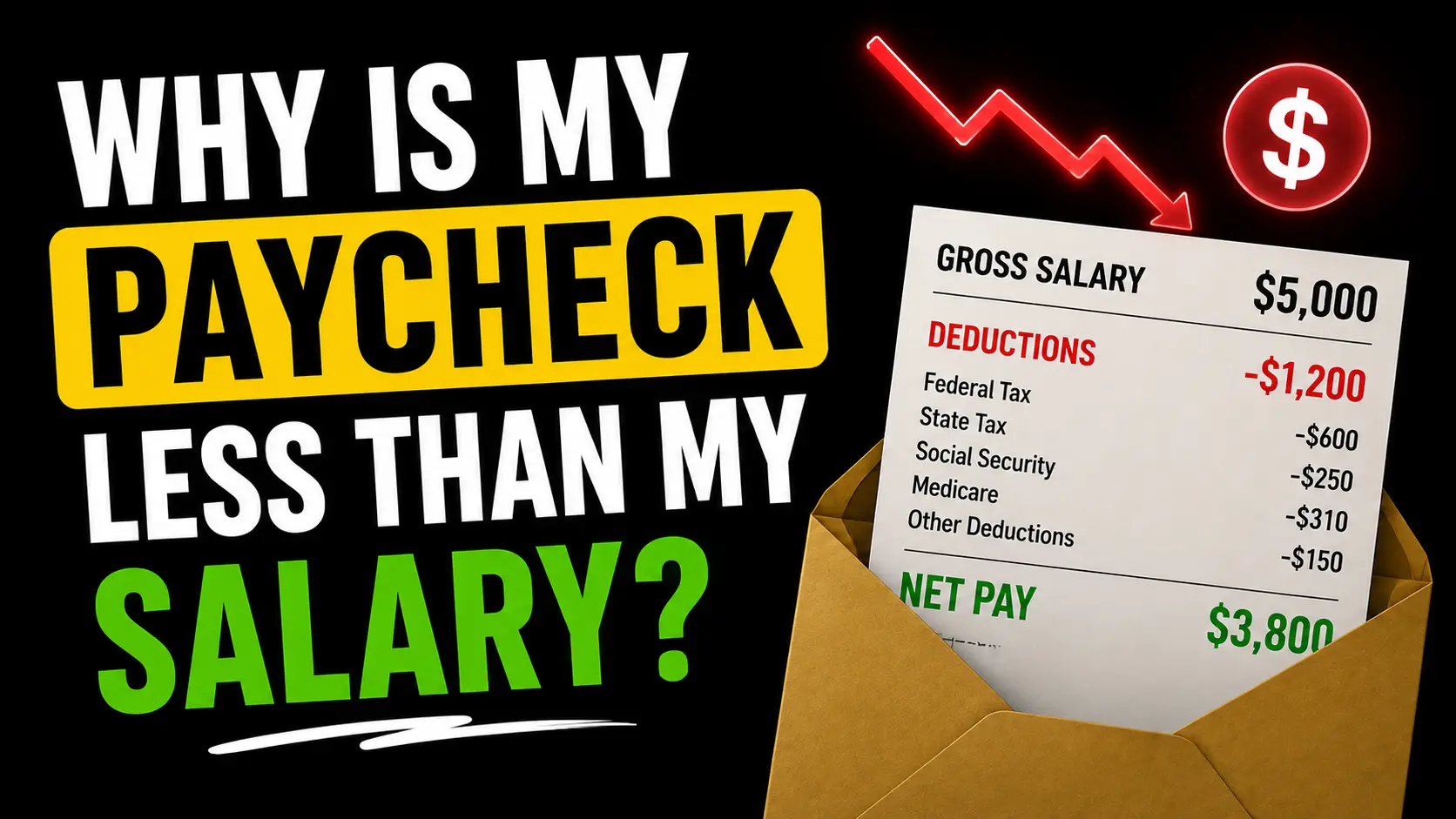
Gross Pay vs. Net Pay — The Two Numbers on Your Stub
Your salary — the number in your offer letter — is your gross pay. It's what you earn before anything is taken out.
Your net pay is what actually lands in your bank account after taxes and deductions do their thing. It's also called take-home pay, and it's almost always significantly lower than gross.
The gap between the two isn't a mistake. It's not your employer skimming money. It's taxes, and it's mandatory.
The Main Things Taking Your Money
Federal Income Tax is usually the biggest chunk. How much depends on your salary and filing status — the US uses a progressive system with rates from 10% up to 37%. On a $60,000 salary as a single filer, you're in the 22% bracket for the top portion of your income, though your effective rate (what you actually pay overall) is closer to 12-13%.
Social Security takes 6.2% of every paycheck, up to the annual wage base of $184,500. No exceptions, no way around it.
Medicare takes another 1.45%. Also flat, also non-negotiable.
Those three alone — federal tax, Social Security, Medicare — account for most of the gap between your salary and your paycheck. On a $60,000 salary with no state tax, you're already losing roughly $600 per biweekly paycheck before anything else happens.
State Income Tax adds more if you live in a state that has it. California can add another 6-9% depending on income. New York adds 4-6%. Texas, Florida, Nevada? Zero. Where you live matters enormously here.
Then There's the Stuff You Opted Into
Beyond taxes, a lot of people have voluntary deductions they signed up for during onboarding — and then forgot about when their paycheck arrived.
Health insurance premiums — if your employer covers part of your insurance, you're probably covering the rest through payroll deductions. This can range from $50 to $300+ per paycheck depending on your plan and employer.
401(k) contributions — if you elected to contribute 5% of your salary to retirement, that's coming out before you see a cent. On $60,000, 5% is $115 per biweekly paycheck. Gone before it hits your account.
Dental, vision, FSA, HSA — if you selected any of these during enrollment, they're all deducted from each paycheck too.
These voluntary deductions are why two coworkers earning the exact same salary can have noticeably different paychecks. One opted into the premium health plan and is maxing their 401(k). The other took the basic plan and isn't contributing to retirement. Same gross pay, different net pay.
A Real Example
Let's put actual numbers on it. Single filer, $60,000 salary, Texas (no state tax), biweekly pay, no voluntary deductions:
Gross per paycheck: $2,307
Federal income tax: −$290
Social Security: −$143
Medicare: −$33
Take-home: ~$1,841
That's $466 gone per paycheck — $12,116 per year — just from mandatory federal taxes. Add a state like California and it drops further. Add health insurance and 401(k) and you could realistically be taking home $1,400-$1,500 on a $60,000 salary.
Want to see your exact number? Run it through the paycheck calculator — it handles federal tax, FICA, and state tax for the most common states.
Why Your First Paycheck Might Be Even Lower
First paychecks are often the smallest, and it throws people off every time.
A few reasons: you might have started mid-pay-period so you're only being paid for part of it. Your benefits elections from onboarding might have all kicked in at once. Some employers withhold at a higher rate for the first paycheck until your W-4 information is fully processed in their system.
If your second paycheck looks noticeably different from your first, that's normal. Give it two or three pay periods to stabilize before assuming something's wrong.
Can You Increase Your Take-Home Without Getting a Raise?
Actually, yes. A few legitimate ways:
Adjust your W-4 — if you're consistently getting a large tax refund at the end of the year, you're over-withholding. Adjusting your W-4 with your employer increases each paycheck now instead of getting a refund later. It's your money either way, but most people prefer it in each check.
Contribute to a traditional 401(k) — counterintuitive, but contributing more to a pre-tax 401(k) reduces your taxable income, which reduces how much federal and state tax is withheld. The contribution itself reduces your paycheck, but by less than the full amount since the tax savings offset part of it.
Use an HSA if you're eligible — Health Savings Account contributions are pre-tax and reduce your taxable income, same principle as 401(k). If your plan qualifies, maxing your HSA is one of the best tax-advantaged moves available.