How to Budget a Paycheck
54% of Americans live paycheck to paycheck. That's not a statistic about poor people — it's a statistic about people who never built a system for where their money goes when it lands.
The fix isn't earning more. It's telling your money where to go before it disappears on its own.
Here's a simple system that works whether you're paid weekly, biweekly, or monthly.
Step 1: Know Your Actual Take-Home Amount
Before you budget anything, you need the real number — not your salary, not your gross pay, but the actual amount that hits your bank account after taxes and deductions.
If you're not sure what that number is, check your most recent pay stub or bank deposit. If you haven't started a job yet and want to estimate it, the paycheck calculator will show you your take-home after federal tax, state tax, and FICA based on your salary and state.
This is your starting number. Budget from this, not from your salary. A lot of people blow their budget in the first week because they planned around $4,800 a month when their actual take-home is $3,600.
Step 2: List Every Fixed Expense
Fixed expenses are the bills that are the same amount every month and non-negotiable. Rent or mortgage, car payment, insurance, subscriptions, loan payments, phone bill.
Write them all down. Every single one. Include the due date next to each one.
Add them up. That total is the floor of what you spend every month no matter what — before groceries, gas, or anything else. If that number is already close to your take-home, you have a structural problem that budgeting alone won't fix. But most people find there's more room than they expected once they actually see the numbers.
Step 3: Estimate Your Variable Expenses
Variable expenses are the ones that change month to month — groceries, gas, dining out, entertainment, personal care, clothes. These are the categories where most budgets fall apart because people either underestimate them or ignore them entirely.
Look at your last two or three months of bank and card statements to get real numbers. What did you actually spend on food last month? On gas? On random Amazon purchases you've already forgotten about?
Use those real numbers, not what you wish you spent. Budgeting based on optimistic guesses is just planning to fail politely.
Step 4: Pay Yourself First
Before you allocate money to anything else, set aside something for savings. Even if it's $50 per paycheck to start.
The reason this works better than saving whatever is left at the end of the month: whatever is left at the end of the month is almost always zero. Treating savings as an expense that comes out first — like rent — means it actually happens instead of just being a good intention.
Where to put it depends on your situation. A basic high-yield savings account for an emergency fund first, then retirement contributions if your employer matches them. Free money from an employer 401(k) match is the closest thing to an instant guaranteed return that exists in personal finance — don't leave it on the table.
Step 5: Assign Every Dollar to a Paycheck
This is the part that makes paycheck budgeting different from monthly budgeting — and the part that makes it actually work for most people.
Instead of making one big monthly budget and hoping it works out, you assign specific bills and expenses to specific paychecks based on their due dates.
Say you get paid on the 1st and the 15th. Rent is due on the 1st — that comes out of the first paycheck. Car insurance is due on the 18th — that comes out of the second paycheck. Groceries and gas get split roughly between both. At the start of each pay period, you know exactly what that specific paycheck needs to cover, and you can see clearly whether you have enough.
This approach eliminates the "where did my money go" problem because you're not managing a monthly pool of money that's easy to mentally underspend early and panic-spend late.
A Simple Framework: The 50/30/20 Rule
If building a detailed expense-by-expense budget feels overwhelming to start, the 50/30/20 rule gives you guardrails without requiring a spreadsheet.
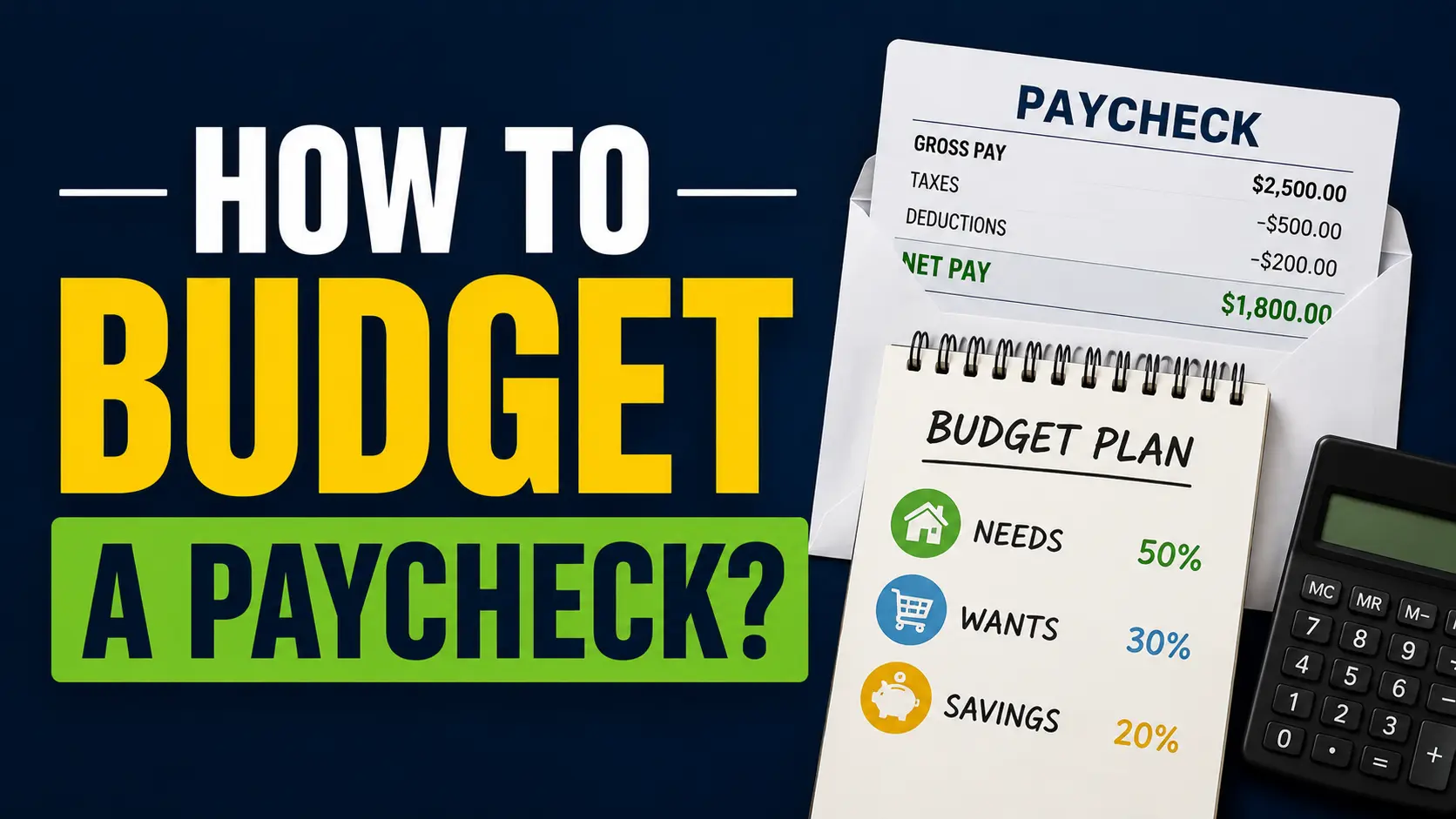
50% of your take-home goes to needs — rent, utilities, groceries, transportation, insurance, minimum debt payments.
30% goes to wants — dining out, entertainment, subscriptions, travel, hobbies.
20% goes to savings and extra debt payments — emergency fund, retirement, paying down debt faster than the minimum.
On a $3,000 monthly take-home: $1,500 for needs, $900 for wants, $600 for savings and debt. These are guidelines, not rules written in stone. If your rent alone eats 40% of your take-home, adjust accordingly — maybe it's 60/20/20 for a while until your situation changes.
The One Thing That Makes Budgets Fail
Budgets don't fail because people are bad with money. They fail because people make one budget and never look at it again.
A budget is only useful if you check it regularly. Weekly is ideal — it takes five minutes to compare what you planned to spend versus what you actually spent. Monthly is the minimum. The goal isn't perfection, it's awareness. Most people who start actually tracking their spending are genuinely surprised by where the money goes, and that surprise alone changes behavior.
Review it. Adjust it when life changes. A budget from six months ago when you got a raise or moved to a cheaper apartment isn't your real budget anymore.
How Much Should You Save From Each Paycheck?
As much as you can without making the budget unsustainable. The 20% guideline is a reasonable target, but starting at 5% or 10% and building from there is better than setting an aggressive goal and abandoning it after a month.
If you recently got a raise, the best time to increase your savings rate is immediately — before lifestyle inflation has a chance to absorb the extra income. Saving 50% of any raise while spending the other 50% is a practical rule that builds wealth without feeling like deprivation.