What Does FICA Mean on My Paycheck?
You get your paycheck, you look at the deductions, and there it is. FICA. Taking a chunk of your money every single pay period without much explanation.
Here's what it actually is, what it pays for, and whether there's anything you can do about it.
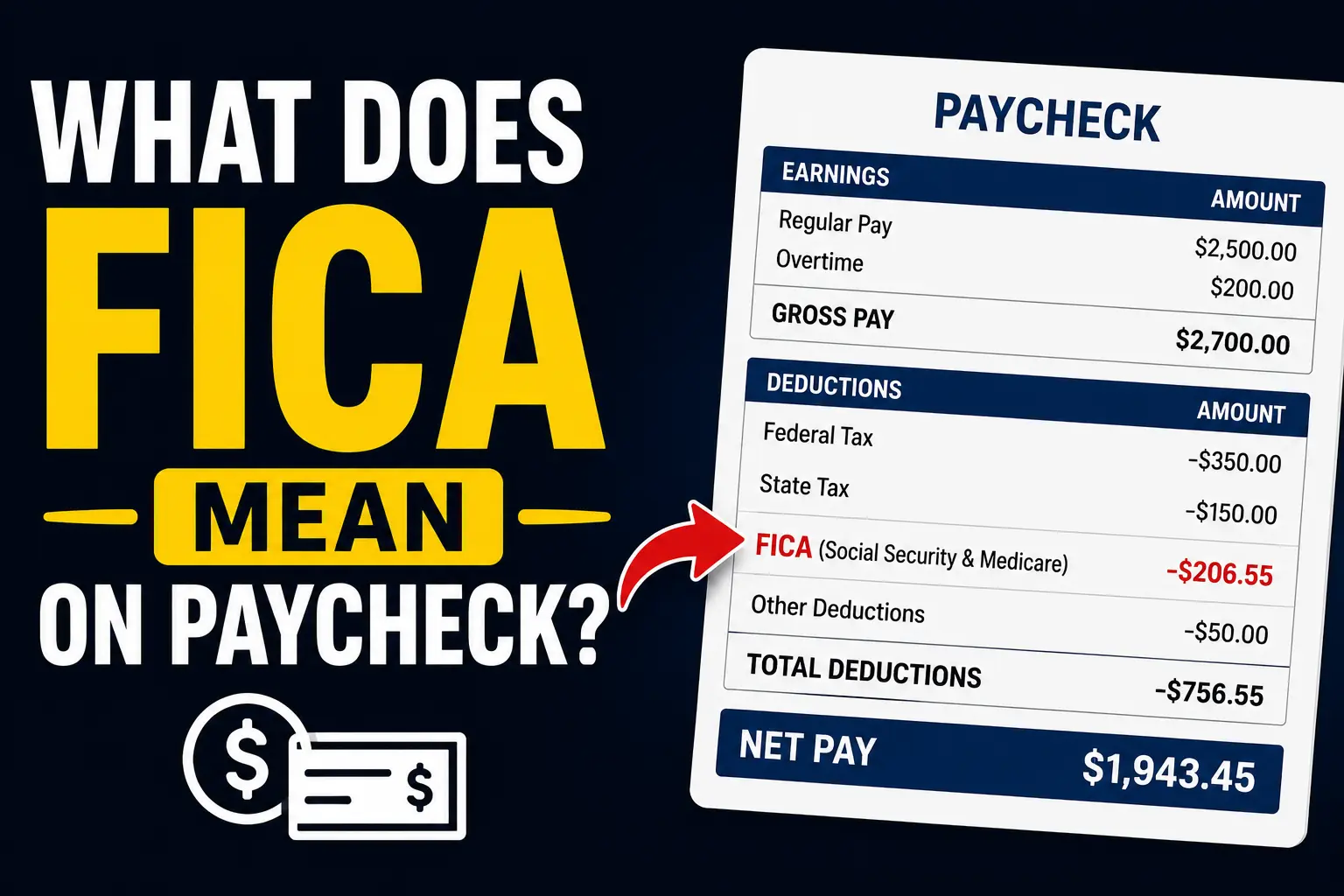
FICA Stands for Federal Insurance Contributions Act
That's the official name. In practice, FICA is just the umbrella term for two separate taxes that get lumped together on your pay stub: Social Security and Medicare.
Both show up under the FICA label because they're both collected the same way — withheld directly from your paycheck by your employer before you ever see the money. Some pay stubs break them into two separate lines. Others bundle them together as one FICA total. Either way, same taxes.
Social Security: 6.2% of Every Paycheck
The Social Security portion of FICA is 6.2% of your gross wages. This one has a cap — in 2026, it only applies to the first $184,500 you earn in a year. Once your year-to-date income crosses that threshold, Social Security withholding stops for the rest of the year and your paycheck gets slightly bigger.
What does it pay for? Social Security funds retirement benefits for current retirees, disability benefits for workers who can no longer work, and survivor benefits for families of deceased workers. The money you pay in today isn't going into a personal account for you — it's paying for current beneficiaries, and future workers will pay for yours when the time comes.
On your pay stub, Social Security might show up labeled as SS, OASDI, or Fed OASDI/EE. OASDI stands for Old Age, Survivors, and Disability Insurance, which is the program's official name. Different payroll systems use different labels but they all mean the same thing.
Medicare: 1.45% of Every Paycheck
Medicare takes a smaller bite — 1.45% of your gross wages. Unlike Social Security, Medicare has no income cap. It applies to every dollar you earn, all year, no matter how much you make.
If your income goes above $200,000 as a single filer or $250,000 for married filing jointly, an additional 0.9% Medicare surtax kicks in on top of the standard 1.45%. Your employer withholds this extra amount automatically once your wages cross the threshold.
Medicare funds the federal health insurance program that covers Americans aged 65 and older, as well as certain younger people with disabilities. Same logic as Social Security — you're paying for current beneficiaries now, and you'll be covered when you reach eligibility.
On your pay stub, Medicare might appear as Fed MED/EE, Medicare Tax, or just Medicare.
How Much Does FICA Actually Cost You?
Combined, Social Security and Medicare take 7.65% of your gross wages on every paycheck. There's no way to reduce this through withholding elections or filing status adjustments — unlike federal income tax, FICA is a flat calculation that doesn't change based on your W-4.
On a $60,000 salary paid biweekly, that's about $176 per paycheck going to FICA. Over a full year, roughly $4,590. On a $90,000 salary, closer to $6,885 per year.
You can see exactly how FICA factors into your take-home pay by running your numbers through the paycheck calculator — it shows Social Security and Medicare as separate line items alongside your federal and state tax.
Your Employer Pays FICA Too
Here's something most employees don't realize: for every dollar of FICA you pay, your employer pays an equal amount on top of it.
You pay 6.2% Social Security and 1.45% Medicare. Your employer also pays 6.2% Social Security and 1.45% Medicare on your behalf — separately, out of their own pocket, not from your wages. So the total FICA contribution on your earnings is actually 15.3%, split evenly between you and your employer.
This is why self-employed people pay 15.3% in self-employment tax instead of 7.65% — they're paying both the employee and employer share since they're both at once. It's one of the less pleasant financial surprises of going freelance or starting a business.
Can You Opt Out of FICA?
Almost never. For the vast majority of American workers, FICA is mandatory. There's no box on your W-4 to reduce it, no filing status that exempts you, no income level that gets you out of it.
There are a small number of narrow exemptions — certain religious group members, some student workers, certain nonresident aliens on specific visa types, and some state and local government employees who participate in alternative pension systems instead. These exemptions are genuinely rare and come with specific requirements. If you think you might qualify, it's worth asking a tax professional rather than assuming.
For everyone else, FICA is just part of the deal. Understanding what it is makes it slightly less annoying, even if it doesn't make it smaller.
FICA vs Federal Income Tax: What's the Difference?
People sometimes confuse FICA with federal income tax since both show up as deductions on the same pay stub. They're completely separate taxes that work differently.
Federal income tax is progressive — the rate varies based on how much you earn, your filing status, and your deductions. It's controlled partly by your W-4 elections. FICA is flat — the same percentage regardless of income level, filing status, or anything else. Your W-4 has zero effect on your FICA withholding.
Federal income tax funds the general federal budget — defense, infrastructure, government operations. FICA specifically and exclusively funds Social Security and Medicare. The money is legally separate and can't be redirected to other government programs.
For a full breakdown of everything that comes out of your paycheck, the pay stub guide walks through every line in plain English.